


The Semantic Mirage: When Accuracy Isn’t Truth
In a previous life, I was deploying document management workflows as a SaaS provider. We took pride in the reports we produced—they were technically impeccable, built on high-performance backends with millisecond precision. But one Tuesday morning, a major customer called in a state of operational crisis.
They had implemented a series of lean management changes to accelerate their internal task completion, but their efficiency reports showed the opposite: the “actual time” per task stagnated, appearing to ignore every improvement they made. To the customer, the system was lying. To us, the data was “correct.”
When we dove into the telemetry, we found the culprit. The report was mixing the PLN_DATE (Planned Date, computed on historical averages) and the ACT_DATE (Actual Date). In certain views, the “duration” calculation was subtracting a historical projection from a real-time fact.
Technically, the database was perfect. The timestamps were accurate. The integrity was “Clean.” But conceptually, the report was a hallucination. The technical system saw two dates; the business system saw a performance failure that didn’t exist. We had provided High-Quality Values without High-Quality Meaning.
In a Silver Data Product, a human expert (the “Chef”) eventually catches this. They notice the numbers don’t move and use their intuition to interrogate the logic. But an Autonomous AI Agent is a literalist. It has zero tribal knowledge, no memory of the SaaS implementation, and no “vagal brake” to stop it when logic is circular. To build a Sovereign Enterprise, we must break the Semantic Ceiling.
The High-Entropy Tax of Ambiguity
As I established in Part 1 of the Architecture of Cognitive Governance, the human brain is capped at a conscious processing limit of ~60 bits per second. When we give an agent—or a human—a dataset without a semantic map, we are imposing a “High-Entropy Tax.” Every time an operator sees a column labeled STATUS_01, their brain must resolve the uncertainty: Does ‘1’ mean ‘Started’ or ‘Completed’? Resolving this ambiguity consumes metabolic energy.
For a human, this leads to Audit Fade and exhaustion. For an AI Agent, this leads to Stochastic Guessing. The agent uses probabilistic patterns to “hallucinate” the missing context. If the agent sees a date, it assumes it knows what that date represents based on its training data, not your specific industrial DNA.
To solve this, we must move the “Intelligence” out of the prompt and into the fuel. We must shift from governing Technical Artifacts to governing Business Data Knowledge.
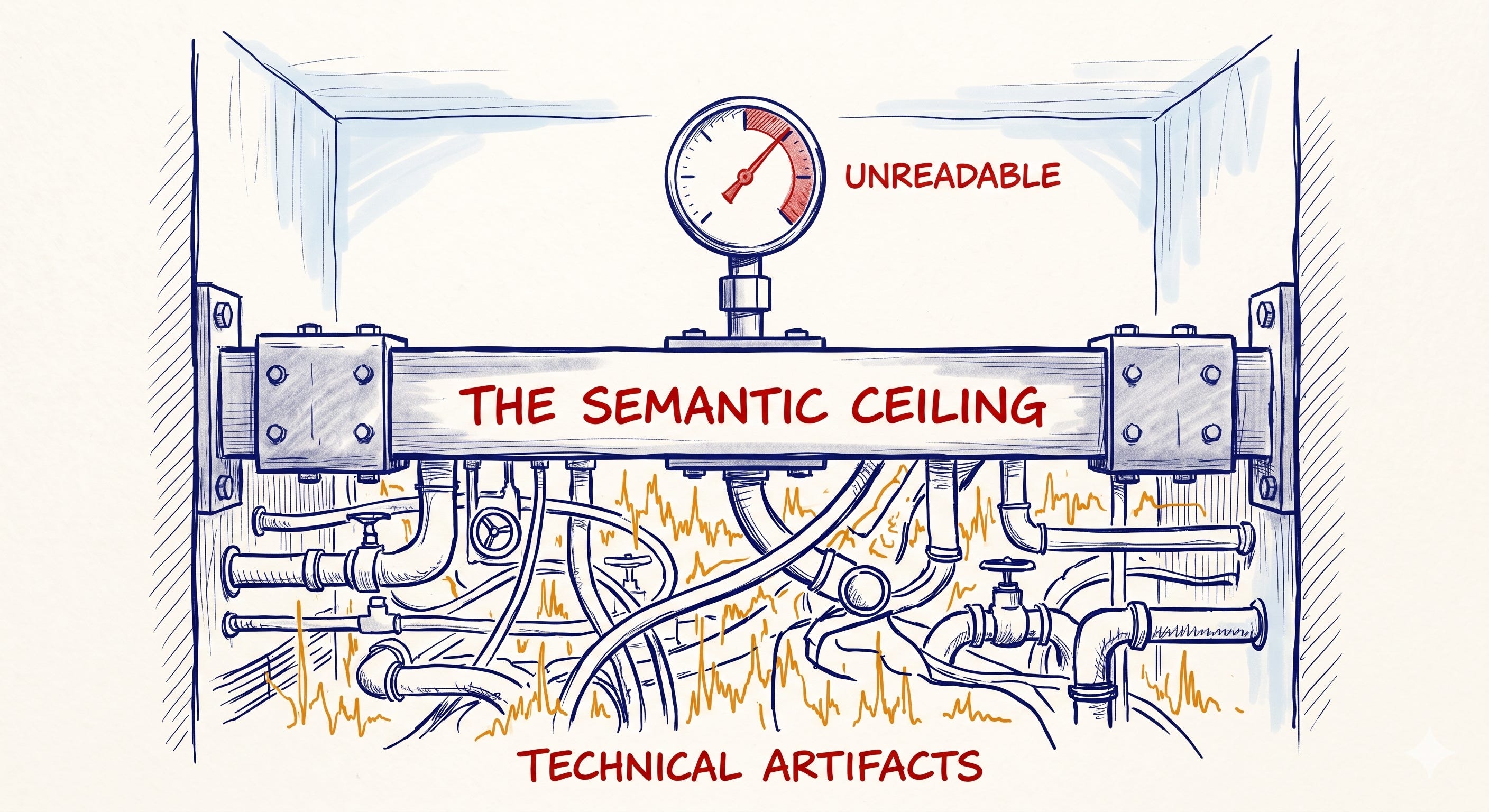
Breaking the “Semantic Ceiling”: The Paradigm Shift
Traditional data management fails because it attempts to govern data from the bottom up—focusing on tables, columns, and schemas. This is the Semantic Ceiling. It is the point where IT excellence meets business illiteracy.
To manage data as a company asset, we must separate knowledge into two distinct, sovereign layers:
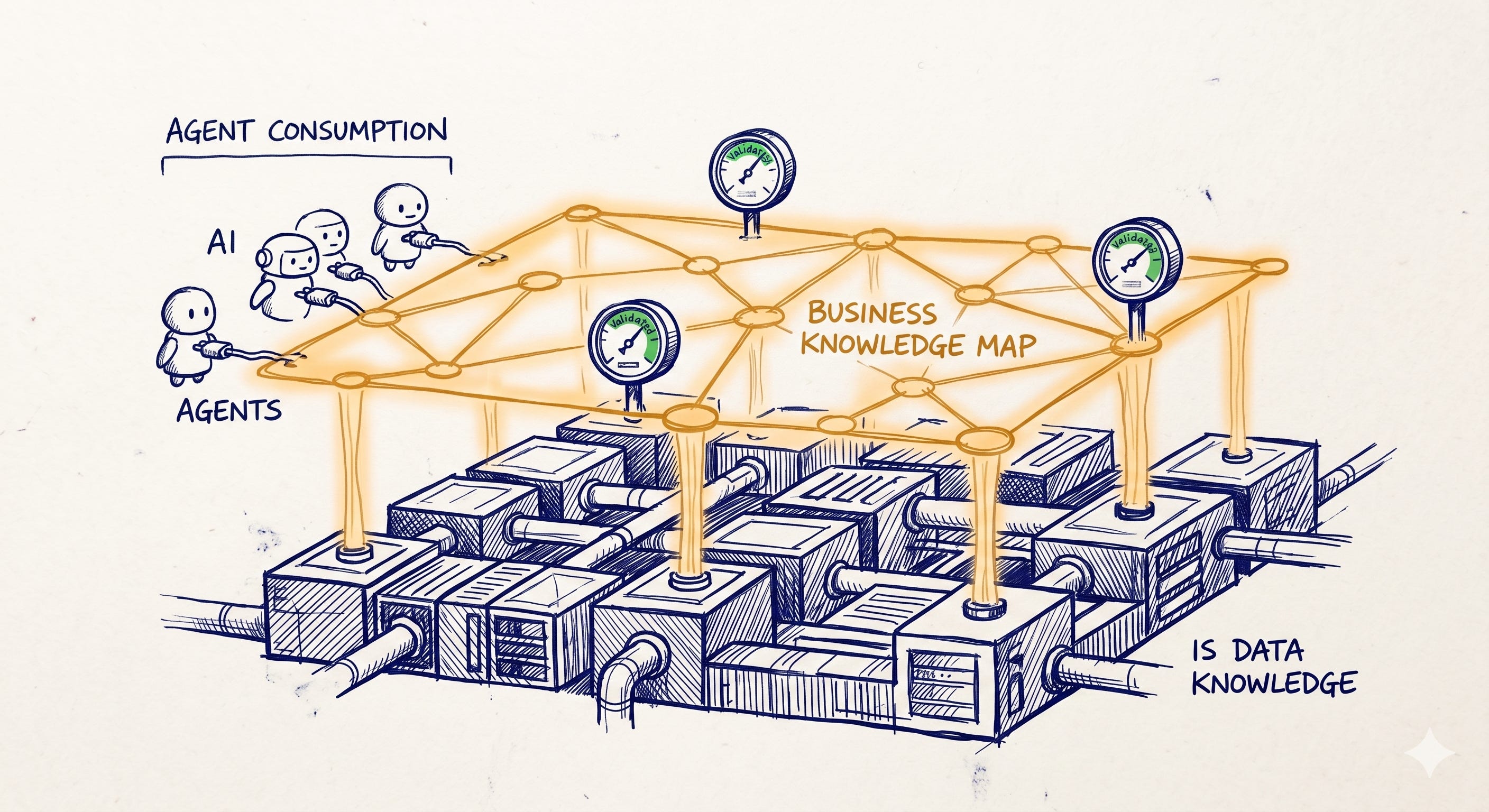
Business Data Knowledge: This is the “What,” the “Why,” and the “Who.” It is a shared language that defines data based on standardized meaning, ownership, and usage rules. It connects business concepts to each other based on value and compliance before any mapping to IT occurs.
IS Data Knowledge: This is the “Where” and the “How.” It is the physical implementation—the technical reality of the tables, APIs, and cloud buckets where the data lives.
Agent-Ready Gold is the bridge between these two worlds. It is an industrial orientation framework consisting of four layers.
The Four Layers of Agent-Ready Orientation
To ensure an AI Agent can operate without “Flying Blind,” the Sovereign Architect must provide a map that covers four scales of reality:
1. Macro-Orientation: The Governance Layer (The Company Map)
Before an agent can process a single row, it needs to know where it is. Think of a flight from Hamburg to Toulouse: you need the European map to understand the trajectory before you need the street-level detail of the destination.
The Governance Layer is the “Company Map.” It lists the domains (Maintenance, Supply Chain, Finance) and the high-level concepts that connect them. It tells the agent that a “Part Number” in the Supply Chain is the same entity as a “Component ID” in Maintenance. This is the first level of orientation that prevents the agent from getting lost in a silo.
2. Detailed Process & Data Blueprint: The Business Knowledge Map
This is the “Blueprint of Reality.” We dig into the domain to create value by detailing the Process Knowledge—down to the specific activities and the data they generate.
Historically, architects used UML diagrams to capture this. While UML is an excellent language for human collaboration, it is often insufficient for autonomous agents. UML is a syntax, but it lacks a built-in “grammar”—it relies on the human reader to know the underlying modeling rules to interpret the intent. For an AI Agent, Ontologies must become the norm.
An Ontology doesn’t just draw the lines; it codifies the logic, the constraints, and the relationships in a machine-interpretable format. It specifies that in our specific industrial DNA, an ACT_DATE is not just a timestamp; it is an immutable fact produced by a specific maintenance activity. By using ontologies, we provide the agent with a “World Model” that it can reason with, rather than a diagram it must try to guess.
3. Technical Exposure: The IS Data Knowledge (The “Plugs”)
Once the logic is defined, we must provide the “How-to-consume” instructions. This is the physical interface—the IS Data Knowledge. A single Data Product 2.0 can have several “Plugs”:
A Structured Set of Tables (The Physical Data Model).
A REST API for real-time queries.
A Model Context Protocol (MCP) contract for direct agentic reasoning.
A Standardized XML Schema following a global industrial norm.
4. Knowledge-to-System Binding: The Rosetta Stone
This final layer is the critical anchor. It is the Knowledge-to-System Binding—the detailed mapping between the Business Knowledge Map (Layer 2) and the Technical Plugs (Layer 3).
This is the bridge that hard-wires the business intent into the technical data. It tells the Agent: “The field Z_TIMESTAMP_01 in this technical API plug is the physical instantiation of the ‘Actual Date’ activity in our Maintenance Blueprint.” This binding allows the Agent to reason with the logic, not just process the values.
In an industrial Gold product, this binding is not a static document; it is a monitored flow. We must monitor the semantic flow through this binding to detect “Semantic Drift.” If the source system code changes (IS Knowledge) in a way that alters the original business meaning (Business Knowledge), the “semantic pressure” drops. Without this real-time monitoring, your AI Agent starts “guessing” the context—reverting to probabilistic patterns (hallucinations) instead of industrial facts.
The Gold Standard: Rigidity and Reactivity
As we established in Part 2, the leap to Gold is defined by a shift from “Transparency” to “Rigidity.”
In a Silver environment, we empower the human with a “Nutrition Label” (QoS) and their professional intuition (the “Knife”) to handle ambiguity. In a Gold environment, we empower the machine with Rigidity. This means:
Zero Ambition Gaps: The “Reality Check” (Part 4) must result in a perfect alignment between the technical plugs and the data flow.
Service Level Agreements (SLA): Because the machine cannot “wait and see,” the human team must commit to a specific Reactivity Time. If the flow drifts, the industrial repair crew is dispatched automatically to fix the binding.
The Cost of Autonomy: Why Gold is Rare
Because of the high requirement for Ontological Modeling, Standardized Technical Plugs, and SLA Commitments, Gold Data Products are expensive to build and maintain. This is why the Sovereign Enterprise treats Gold as a rare and precious resource, reserved only for the most critical End-to-End Digital Thread. For 80% of your analytics, Silver remains the optimal target.
Conclusion: Engineering for the Machine
The transition to the Cognitive Age is not about making machines “smarter.” It is about making our data products “Sharper.”
By breaking the Semantic Ceiling and providing our Agents with the Governance Map, the Process Ontology, and the Knowledge-to-System Binding, we stop them from hallucinating and start them producing. We move from “Experimentation” to “Industrial Transformation.”
In the final article of this series, we will look toward 2030 with Part 6: Data Product 3.0, where internal “Trustworthy” claims become external “Certification.”
Peer Discussion: Is your organization still relying on human-only diagrams like UML for AI readiness, or are you moving toward machine-interpretable Ontologies? Let’s connect for a discussion.
Series Navigation:
[Part 1: The Data Product 2.0 is Not an API] | [Part 2: Fit for Purpose] | [Part 3: Flying Blind] | [Part 4: The Reality Check] | Part 5: Agent-Ready Gold | [Part 6: Data Product 3.0]